
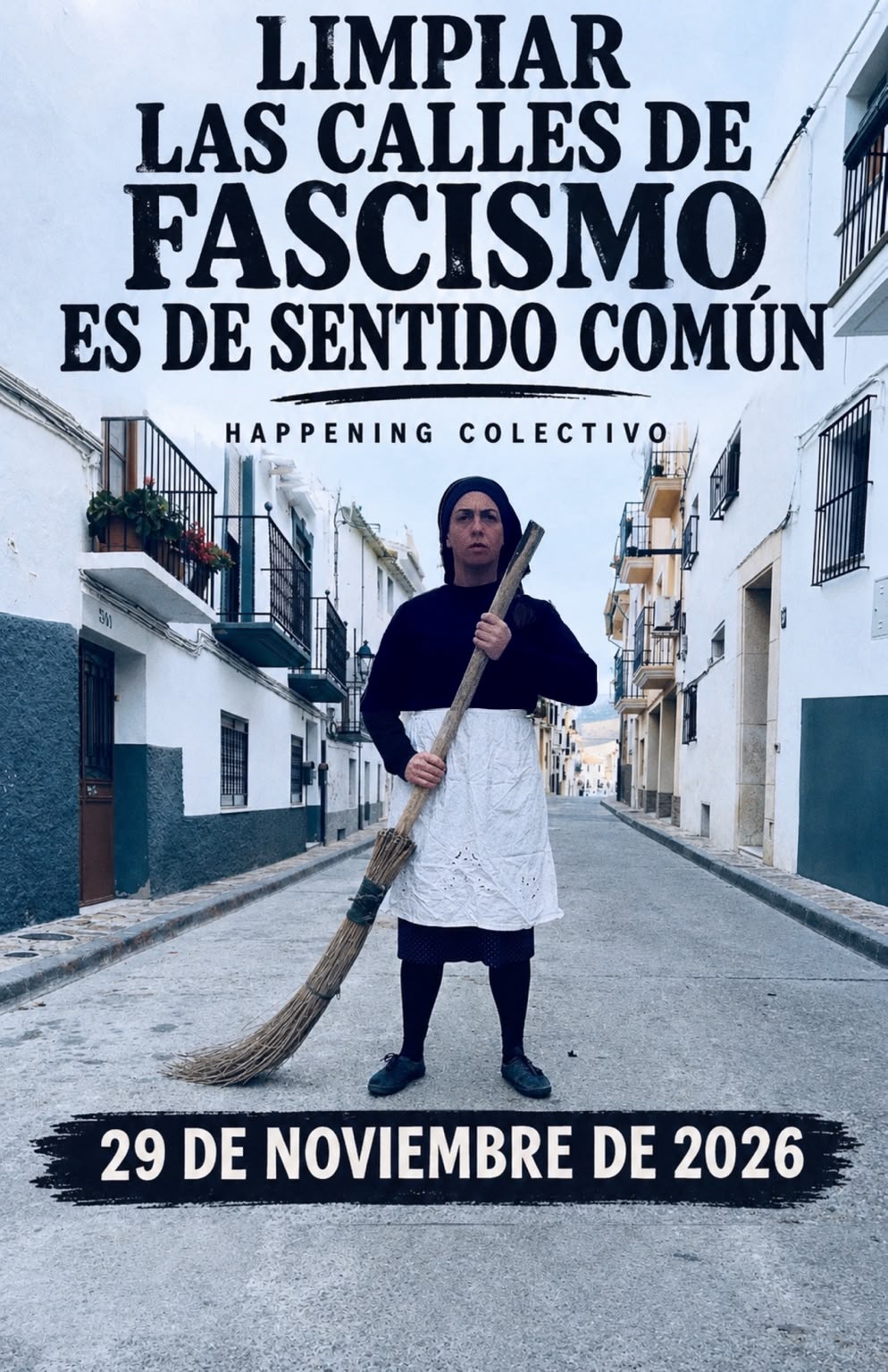
Performance colectiva
Barrer el Fascismo
📅 Fecha: 29/11/2026
⏰ Horario: Todo el día
🎟️ Precio: Gratis €
LIMPIAR LAS CALLES DE FASCISMO ES DE SENTIDO COMÚN
Happening colectivo
Domingo, 29 de noviembre 2026
En 1907, miles de familias trabajadoras y migrantes de Buenos Aires lucharon contra los alquileres abusivos, la pobreza y la desigualdad. Las mujeres salieron a la calle con sus escobas. Lo llamaron la Marcha de las Escobas.
Casi 120 años después, seguimos hablando de vivienda digna, precariedad y desigualdad.
Durante la represión franquista, mujeres republicanas, conocidas como «las pelonas» por haber sido rapadas, fueron obligadas a barrer las calles como castigo y humillación pública.
El mismo gesto. La misma herramienta. Otro significado.
La escoba ya no como instrumento de sometimiento, sino como símbolo de libertad.
En 1973, la artista Mierle Laderman Ukeles limpió durante cuatro horas las escalinatas del museo Wadsworth Atheneum, en Estados Unidos, convirtiendo una tarea cotidiana en un acto de expresión artística y reivindicación social, visibilizando el trabajo doméstico y de cuidados históricamente relegado a las mujeres.
Limpiar también es una forma de alzar la voz.
El derecho de las mujeres a decidir sobre sus propios cuerpos, a interrumpir voluntariamente un embarazo y a vivir libres de violencia machista forma parte de nuestra libertad colectiva.
En los Premios Feroz de 2026, Samantha Hudson cuestionaba, desde la ironía, cómo los fascistas responsabilizan a los colectivos más vulnerables de los problemas de nuestra sociedad.
¿Desde cuándo el derecho a existir de unas personas supone una amenaza para otras?
¿Y qué es el sentido común? ¿Desde cuándo pertenece a un partido político?
El sentido común se construye colectivamente. No se impone.
La libertad es de sentido común. El odio no.
La diversidad no es una amenaza.
Poder pagar el pan y tener una vivienda digna es un derecho común. Decidir sobre nuestro propio cuerpo es un derecho fundamental.
No queremos limpiar las calles de personas, sino del odio que nos enfrenta.
Una escoba. Un gesto. Una expresión de libertad.
Defender nuestra libertad es responsabilidad de todas las personas.
Porque incluso quienes no tienen derecho a votar —personas migrantes, menores de edad— tienen derecho a opinar.
La escoba: un símbolo de libertad colectiva.
La acción comienza con un gesto individual. Os invito a salir a la calle el domingo 29 de noviembre de 2026, a votar con la escoba en mano, como símbolo de vuestra libertad.
A las 12:00 horas, quienes puedan y quieran participar en el happening colectivo podrán reunirse frente a los ayuntamientos de sus respectivas localidades para barrer colectivamente durante quince minutos.
La escoba como herramienta de libertad.
?
CLEANING FASCISM OFF OUR STREETS IS COMMON SENSE
Collective happening
In 1907, thousands of working-class and migrant families in Buenos Aires fought against exploitative rents, poverty and inequality. Women took to the streets with their brooms. They called it the March of the Brooms.
Almost 120 years later, we are still talking about decent housing, precarity and inequality.
During Francoist repression, Republican women, known as las pelonas because their heads had been shaved, were forced to sweep the streets as a form of punishment and public humiliation.
The same gesture. The same tool. A different meaning.
The broom no longer an instrument of subjugation, but a symbol of freedom.
In 1973, artist Mierle Laderman Ukeles spent four hours cleaning the steps of the Wadsworth Atheneum Museum in the United States, transforming an everyday task into an act of artistic expression and social advocacy, bringing visibility to domestic and care work historically relegated to women.
Cleaning is also a way of making our voices heard.
Women’s right to make decisions about their own bodies, to choose to terminate a pregnancy and to live free from gender-based violence is part of our collective freedom.
At the 2026 Feroz Awards, Samantha Hudson used irony to challenge the way fascists blame the most vulnerable groups for the problems in our society.
Since when has one person’s right to exist posed a threat to another?
And what is common sense? Since when has it belonged to a political party?
Common sense is shaped collectively. It cannot be imposed.
Freedom is common sense. Hatred is not.
Diversity is not a threat.
Being able to afford bread and have a decent home is everyone’s right.
Deciding what happens to our own bodies is a fundamental right.
We do not want to rid our streets of people, but of the hatred that divides us.
One broom. One gesture. One expression of freedom.
Defending our freedom is everyone’s responsibility.
Because even those who do not have the right to vote — immigrants and minors — have the right to express their opinions.
The broom: a symbol of collective freedom.
The action begins with an individual gesture. I invite you to take to the streets on Sunday, 29 November 2026, to vote broom in hand, as a symbol of your freedom.
At 12 noon, those who are able and wish to participate in the collective happening can gather outside their local town halls to sweep together for fifteen minutes.
The broom as a tool for freedom.